

In the 1970 FIFA World Cup, Adidas debuted the Telstar: the most iconic soccer ball design ever. The Telstar, with its black-and-white panels, not only suited the monochrome televisions of the time — it went on to become the de facto symbol of the world’s biggest sport.
Over five decades later, Adidas continues to supply the single most important piece of equipment to the World Cup. Now the German sportswear giant seeks to redefine the soccer ball again. This time, Adidas wants to change its inner workings, and do the same for many other sports balls.
In its U.S. patent application, Adidas describes a replacement for traditional inflated sports balls, which tend to lose pressure over time and with use. Currently, tennis balls require disposal; and soccer balls, basketballs, or volleyballs require reinflation. All this while carrying the risk of leakage and puncture.
Adidas’s design may still feature a surface layer of rubber or leather, to grant water and abrasion resistance as well as resilience for low deformations. The innovation is in the lattice structure below the surface, comprising beams connected at the ends.
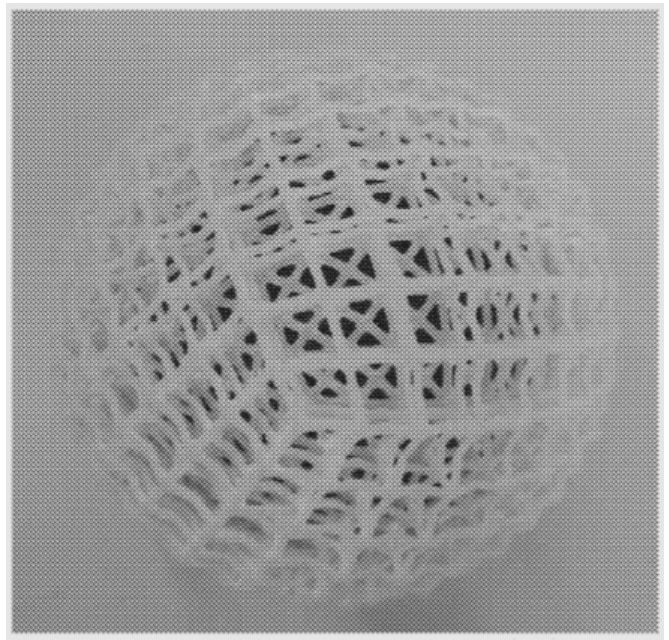
Adidas says the structure is designed to support balanced, high-performance sports balls with consistent bouncing and rebound properties. It builds upon past attempts at airless sports balls with processes like 3D printing and materials like foam.
The application touts the lattice structure’s myriad of design options, which means any particular sports ball’s properties and feel can be tailored to a customer’s requirements. This includes modifying a ball’s weight distribution to engineer its angular momentum of inertia. Evenly distributed lattice cells also mean the ball is perfectly balanced, and the beams that form the lattice can be substituted for tubes to lessen a ball’s weight even further.
If the airless sports ball patent is granted and the lattice approach it describes is adopted, Adidas may take yet another step in the evolution of soccer ball design. For sporting goods at large, the company may also be able to convert and corner a hefty portion of the $3.59-billion inflatable ball market.