

As COVID-19 becomes a global pandemic, we see a dramatic rise in the demand for ventilators. In severe cases of the coronavirus, the virus causes damage to the lungs which triggers an immune response by the body: the blood vessels inside the lungs are expanded to allow more immune cells to enter. However, this can also cause fluid to enter the lungs, making it difficult for a patient to breathe. To combat this, mechanical ventilators are used to help supply the lungs with oxygen when a patient’s lungs can no longer function. Ventilators will provide oxygen to the body while it fights off the virus.1
We took a look at some patents disclosing mechanical ventilators and the components used in their operation:
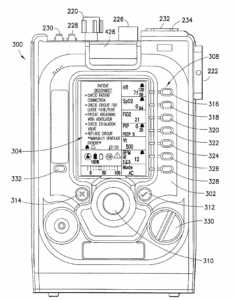
U.S. Patent No. 9,283,339
Life support and monitoring apparatus with malfunction correction guidance
| Current Assignee: Zoll Medical Corp |
| Priority Date: 18 May 2009 |
| Abstract: A life support and monitoring apparatus with malfunction correction guidance is provided. The life support and monitoring apparatus of the present disclosure identifies the root cause or potential cause of a fault/failure and then prompts an operator to take appropriate steps to assure the continuance of life support and critical physiologic monitoring. When multiple faults/failures exist, the apparatus automatically prioritizes them based on risk to the patient and prompts the operator to do the most appropriate intervention to assure patient safety. |
| Forward Citations: 76 |
Zoll Medical, a Chelmsford-based defibrillator maker, is shifting its focus on its ventilator production to provide portable ventilators to hospitals in need fighting the coronavirus.2 Zoll Medical Corp has a patent for a ventilator module that continually monitors a mechanical ventilator for faults that may occur and seeks the appropriate steps to ensure continuance life support and physiological monitoring.
U.S. Patent No. 9,027,552
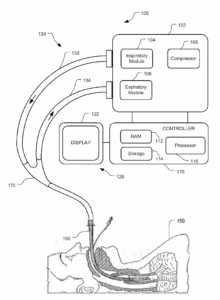
Ventilator-initiated prompt or setting regarding detection of asynchrony during ventilation
| Current Assignee: Covidien LP |
| Priority Date: 31 July 2013 |
| Abstract: This disclosure describes systems and methods for monitoring and evaluating ventilatory parameters, analyzing those parameters and providing useful notifications and recommendations to clinicians. That is, modern ventilators monitor, evaluate, and graphically represent multiple ventilatory parameters. However, many clinicians may not easily recognize data patterns and correlations indicative of certain patient conditions, changes in patient condition, and/or effectiveness of ventilatory treatment. Further, clinicians may not readily determine appropriate ventilatory adjustments that may address certain patient conditions and/or the effectiveness of ventilatory treatment. Specifically, clinicians may not readily detect or recognize the presence of asynchrony during ventilation. According to embodiments, a ventilator may be configured to monitor and evaluate diverse ventilatory parameters to detect asynchrony and may issue notifications and recommendations suitable for a patient to the clinician when asynchrony is implicated. The suitable notifications and recommendations may further be provided in a hierarchical format. |
| Forward Citations: 52 |
Medtronic recently made public all the schematics and software required to build a portable mechanical ventilator and authorized anyone to use them for free to manufacture the lifesaving devices for the duration of the coronavirus pandemic. The model whose specs were published is the Puritan Bennett 560, a popular portable respirator that Ireland-domiciled Covidien launched in 2010, a few years before Medtronic merged with it.3 A patent of Covidien describes ventilator-implemented methods of detecting a possible ventilator asynchrony before it occurs and then issue a smart prompt containing a recommendation for an operator to prevent the possible ventilator asynchrony.
U.S. Patent No. 8,726,902
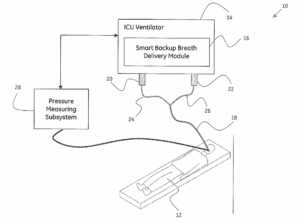
System and method for smart delivery of backup breaths
| Current Assignee: Covidien LP |
| Priority Date: 31 July 2013 |
| Abstract: A method for delivering ventilatory support to a patient is presented. The method includes controlling delivery of a first backup breath by delaying onset of the first backup breath, wherein delaying the onset of the first backup breath is configured to allow selection of an appropriate backup rate. Systems and computer-readable medium that afford functionality of the type defined by this method is also contemplated in conjunction with the present technique. |
| Forward Citations: 13 |
General Electric has joined the fight against the coronavirus by boosting its production of mechanical ventilators and other medical equipment.4 A patent of General Electric describes a smart delivery circuit for mechanical ventilators used to control delivery of air during changes in breathing rates and can differentiate changes such as slowing down, speeding up or temporarily pause in breathing. This prevents uncomfortable asynchronous breathing for patients.
U.S. Patent No. 10,384,030
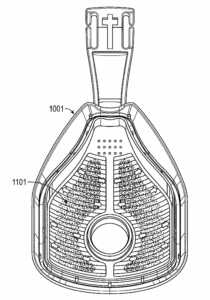
Medical components with microstructures for humidification and condensate management
| Current Assignee: Fisher and Paykel Healthcare Ltd |
| Priority Date: 14 March 2013 |
| Abstract: New medical circuit components and methods for forming such components are disclosed. These components include microstructures for humidification and/or condensate management. The disclosed microstructures can be incorporated into a variety of components, including tubes (e.g., inspiratory breathing tubes and expiratory breathing tubes and other tubing between various elements of a breathing circuit, such as ventilators, humidifiers, filters, water traps, sample lines, connectors, gas analyzers, and the like), Y-connectors, catheter mounts, humidifiers, and patient interfaces (e.g., masks for covering the nose and face, nasal masks, cannulas, nasal pillows, etc.), floats, probes, and sensors in a variety of medical circuits |
| Forward Citations: 7 |
Demand for Fisher & Paykel Healthcare’s mechanical ventilator humidifiers has surged due to the coronavirus crisis. In response, the New Zealand based company has ramped up production in its production plants in New Zealand and Mexico.5 A patent of Fisher & Paykel Healthcare describes a medical circuit with microstructures for humidification and condensate management of air used in ventilators.
U.S. Patent No. 10,576,237
Active exhalation valve
| Current Assignee: Ventec Life Systems Inc |
| Priority Date: 24 March 2015 |
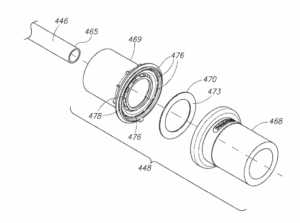
| Abstract: An active exhalation valve for use with a ventilator to control flow of patient exhaled gases. The valve includes a patient circuit connection port, a patient connection port, an exhaled gas port, a pilot pressure port, and a valve seat. The valve further has a movable poppet with inner and outer bellows members and a bellows poppet face. An activation pressure applied to the pilot pressure port extends the bellows members to move the poppet face into engagement with the valve seat and restrict flow of patient exhaled gases to the exhaled gas port, and the reduction of the activation pressure allows the bellows members to move the poppet face away from the valve seat and out of engagement with the valve seat to permit flow of patient exhaled gases to the exhaled gas port, thereby controlling the flow of patient exhaled gases from the valve. |
| Forward Citations: 1 |
General Motors Co. has partnered with Ventec Life Systems in order to make mechanical ventilators for the Health and Human Services Department of the US government to add to the national stockpile in response to the coronavirus epidemic. [6] A patent of Ventec Life Systems describes an active exhalation valve for use with a mechanical ventilator to control flow of patient exhaled gases for cases when a patient needs to have their lungs or airways cleared of secretions without having to completely remove the ventilator.
Related articles

Coronavirus Patent Landscape Report
Electronic Health Records Newsletter
References
[ordered_list]
-
- “Coronavirus: What are ventilators and why are they important?,” BBC News, 7 April 2020. [Online]. Available: https://www.bbc.com/news/health-52036948. [Accessed 15 April 2020].
- S. P. Cotter, “Chelmsford-based ventilator company Zoll ramping up production to battle coronavirus,” SEAN PHILIP COTTER, 22 March 2020. [Online]. Available: https://www.bostonherald.com/2020/03/22/coronavirus-has-chelmsford-ventilator-company-ramping-up-production/. [Accessed 15 April 2020].
- C. Renauer, “Medtronic Makes Plans for a Ventilator Open-Source,” Nasdaq, 30 March 2020. [Online]. Available: https://www.nasdaq.com/articles/medtronic-makes-plans-for-a-ventilator-open-source-2020-03-30. [Accessed 16 April 2020].
- S. V. Voorhis, “General Electric Boosts Production of Ventilators, Medical Equipment,” The Street, 19 March 2020. [Online]. Available: https://www.thestreet.com/investing/general-electric-ventilators-coronavirus. [Accessed 16 April 2020].
- S. Evans, “Demand surge for Fisher & Paykel’s respiratory devices,” Financial Review, 17 March 2020. [Online]. Available: https://www.afr.com/companies/healthcare-and-fitness/fisher-and-paykel-healthcare-respiratory-devices-demand-surge-20200317-p54as9. [Accessed 15 April 2020].
- D. Welch, “GM Lands U.S. Ventilator Contract Worth Almost $500 Million,” Bloomberg, 8 April 2020. [Online]. Available: https://www.bloomberg.com/news/articles/2020-04-08/gm-secures-almost-500-million-u-s-contract-to-make-ventilators. [Accessed 15 April 2020].
[/ordered_list]